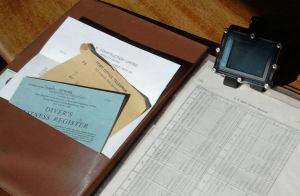
 In diving’s pre-computer age, many occupational divers compiled their own work manuals filled with essential safety information like decompression and therapeutic recompression tables, basic treatment for pressure-related illnesses, and useful trivia … including, in some instances, job offer letters. My manual sat on the shelf unopened – until recently – for years.
In the very early ‘Seventies, offshore divers working on the North Sea gas and oil fields were in heavy demand. Letters and telegrams offering alternate diving employment opportunities were an almost weekly occurrence.
In August 1972 – having ignored the previous letter sent from the same company a year earlier – I received a second letter from one of the Directors saying that they had a vacancy that they felt might interest me, and would I please telephone the London offices of D.H.B. Construction Limited, and arrange a meeting. Although happy with my present offshore job, I called and made an appointment.
The meeting with several members of the company’s Board was relaxed and focused on my thoughts about offshore diving in general and the role of one atmosphere diving suits as well as submersibles – machines that were, then, gradually making their presence felt as a possible replacement for divers in deep water operations – and whether I was open to being trained in the use of the technology?
Blessed with the ignorance – and arrogance – of youth, and a mind filled with images of the early clunky, steam-punk armoured diving dresses, I confidently assumed that the emphasis was on submersibles, brushed the concept of armoured diving dresses to one side and suggested that mechanical claws and grabs might be useful for certain underwater roles, but that they’d never, ever replace a saturation diver’s human ability to delicately do up a nut-and-bolt ‘finger-tight’.
Unsurprisingly, in light of later knowledge, I failed the interview. Although, at a personal level, I believed that my scepticism regarding submersible operations were well founded when, in June 1973 of the following year, the submersible, Johnson Sea Link, became trapped for 24-hours in the wreckage of a purpose sunk vessel at a depth of 100 metres.
Designed by Ed Link, the creator of the aircraft pilot training simulator, the submersible was freed, but of the four crew members, two – including Link’s son – died of CO2 poisoning. An earlier submersible designed by Link had been found to be unsafe at deeper depths because of the use of different materials – with different coefficients of expansion and contraction.
A month later, two British sailors became trapped when their submersible, Pisces III, plunged 1,600 feet into a North Atlantic deep 150-miles off Ireland. A seventy-six hour international rescue operation swung into action. Eventually managing to bring the two trapped men to the surface with just 12-minutes of oxygen remaining.
It was only later that I discovered that the job that I had unsuccessfully interviewed for was as a test guinea-pig of a one-atmosphere diving suit, whose design was being financed by the British Government as an aid to petro-chemical exploration.
Based on an armoured diving dress developed in the 1920’s by Joseph Peress, one that used patented hydraulic joints, the armoured, ‘Tritonia’, diving suit – was used to locate the wreck of the SS Lusitania, in 1935. Although there was little interest by either the Navy or Commercial diving interests at the time, the Peress design formed the basis of D.H.B. Construction Limited’s ADS (Atmospheric Diving Suit) named after the first diver to use the Peress-designed dress on the dive to the Lusitania, JIM Jarret.
The later designs, exhaustively tested in the Royal Navy’s physiological laboratories, ultimately led to Oceaneering acquiring the licence rights to the suit and their ultimate deployment into the offshore oil industry.
On September 19th, 1979 – seven years after I talked myself out of the opportunity – renowned oceanographer, and National Geographic explorer-in-residence, Dr Sylvia Earle made history when she spent two and a half hours walking on the seabed at 1,250 feet in a one-atmosphere self-contained diving system named ‘JIM’ – the deepest open-sea scientific dive ever made in a Jim suit.
—ENDS—
Categories: History
 NEKTONIX