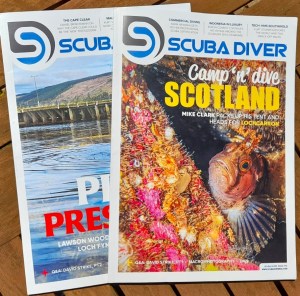
Scuba Diver U.K.
Mark Evans – Editorial Director of ‘Scuba Diver UK’ – recently invited me to join him in a Q&A session; one that (thanks to my verbosity) he ran over two issues of the magazine.
While omitting many of the images used in our lengthy chat, the following – for those with the patience to read my rambling responses to Mark’s questions – is the session in its entirety.
————————
Q: As we normally kick off proceedings, how did you first get into scuba diving?
A: Growing up in a post-WWII family with strong Naval connections (my paternal grand-father had served as a Royal Navy submariner during WWI; one of his two sons, my Dad’s younger brother, was a commercial diver involved in salvage operations, and on the other side of the family – for the most part, Royal Marines – was another relative, one whom I’d never met, but who was apparently something to do with diving) the stories overheard at family get-togethers were, invariably, those relating to the Senior Service, their sea-borne operations, submarines, ship-wrecks, salvage, and diving … and ‘frogmen’, a snappy, media-inspired title bestowed on those free-swimming divers involved in some of WWII’s more audacious underwater combat operations.
In the late 1940’s, one of my Dad’s friends, a Chief Petty Officer based at HMS Excellent, the Royal Navy’s Gunnery School at Whale Island, invited us to visit him in Portsmouth and view one of the first post-war, ‘Navy Days’; an annual PR exercise in which, over several days, the public were given an opportunity to take tours of Royal Navy vessels and view simulated action displays.
I still have several distinct memories of that visit to HMS Excellent: the most vivid being a visit to Portsmouth’s Royal Naval Dockyard where, standing on the side of a flooded dry dock, I watched pairs of divers, dressed in sleek rubber suits and wearing oxygen rebreathers, straddle the backs of large, torpedo-shaped, machines – dubbed, ‘human torpedoes’ by the popular press – that they guided beneath the oily green waters in a simulated demonstration of an attack on enemy shipping.
It was the beginning of a lifelong fascination with divers and diving. One that included a brief flirtation with a local branch of the British Sub Aqua Club before joining the Royal Navy.
Completing basic training and assigned to my first ship – still under refit before sailing for the Far East – I responded to a message placed on the ship’s Notice Board calling for volunteers for diving duties – it was on the cusp of the change-over from O2 rebreathers to open-circuit apparatus – for the Navy’s four-week entry-level Ship’s Diver course, then held in the Diving School at HMS Drake, the Royal Navy Barracks and dockyard in Plymouth.
It was a course with a high failure rate, previous applicants returning after a few days, or a week or so, with tales of hardship and horror that obliged them to voluntarily withdraw from the course. I immediately put in a request form to be considered for acceptance – this was, after all, one of my reasons for joining the Navy – and was summoned to an interview with the ship’s newly appointed Diving Officer, who approved my request.
At 18, with my draft papers clasped in my hand and kit bag over my shoulder, I presented myself to the Chief Petty Officer Clearance Diver in charge of the Diving School at HMS Drake.
“What’s your name lad?” He asked
“Strike, Chief.” I replied in a wavery voice
“Strike, eh? I’ve got some relatives called Strike. What’s your father’s name?”
“Billy – I mean, William – Chief.” I nervously replied
“Billy, eh? I’m your Uncle, lad. You will pass this course”
This, of course, is the sort of thing that all young recruits like to hear. At that point – and I gladly confess to
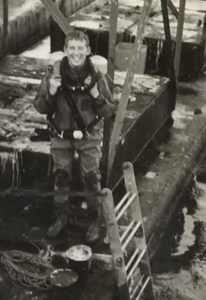
Malta 1965
mistaking what he intended as an order, as a statement of fact – I didn’t know the meaning of the word ‘nepotism’, but if I had, I would have seen nothing at all wrong with it. 😊
Needless to say, there was a downside. When the Petty Officers and Leading Hands conducting the day-to-day training heard that I was related to the Chief, I became an involuntary ‘volunteer’ for additional swims and exercises. And while there were times when I almost withdrew from the course, I was too afraid to fail. Of the close to thirty volunteers that had started the course, five of us passed.
It marked the start of a long and on-going learning curve about diving … and one filled with many memorable episodes.
Q: You have got a mixed bag of diving experience, ranging from recreational and technical diving to commercial and even military diving. Which have you found the most challenging?
A: That’s a rather difficult question with no simple or direct answer. Certainly, the most economically challenging would have to be – in my case – Technical Diving because of its affordability. Rarely offering any financial return, the costs involved in Technical Diving – in terms of equipment, training and gas – can be prohibitive. (And possibly lead to its acceptance as some sort of elitist category of diving … which it is not.) 😊
However – and again because of economics – occupational diving has its own share of challenges. Not least being the complexity of a task, the time required to complete it, and environmental considerations. While recreational and technical divers have the luxury of being able to call a dive if conditions are less than perfect, occupational divers constantly face the prospect of losing a contract to a competitor if they consistently fail to complete a job on time … regardless of environmental factors.
I should also add that those two examples lose sight of the fact that distinctions between Occupational Diving and Technical Diving are sometimes – and increasingly – being blurred by the fact that while Technical Divers are not subject to the same strict standards and regulations that govern Occupational Diving in many parts of the world, they often – through sponsored, or self-funded programmes – carry out tasks that were once regarded as being ‘commercial’ in their scope.
 If, however, the extent and quality of the training is taken into consideration then the Military wins … by a mile. Far too few – if any – Recreational/Technical training organisations have either the expertise, or the time, to properly train a person as a diver to that point where the requisite life-saving skills are impressed into ‘muscle-memory’ and become an automatic response to a situation.
And the training for the military is long, hard, and not based on the personal profit motive. Consequently, people fail the course. Something that seems to happen but rarely in the fast-food philosophy common to many commercially-driven Recreational Training organisations.
Q: You are qualified on various rebreathers as well as well-versed in open circuit tech diving and have a raft of certifications from agencies such as PADI, SSI, BSAC, IANTD and ANDI. What is it that draws you to technical diving?
A: I’m always hesitant about use of the word ‘qualified’. Far too many people in diving are convinced that the terms, ‘certified’ and ‘qualified’ mean much the same thing. They don’t. At a personal level, I view both as being at opposite sides of the diver training spectrum. While it’s true that I have first-hand experience of four rebreathers, I regard myself, by any standard, as being ‘certified’ rather than ‘qualified’. Patience is now no longer one of my virtues; and to my way of thinking – given the necessary time spent in pre-dive checks and post-dive maintenance – patience is an absolute essential when it comes to rebreather diving safety … as is constant practice and regular and recent use of the machine.
(It seems to me that, in many instances, Certification Cards with no expiry date become, for many divers, an end in themselves and cheapen the value of a technical diving qualification … but that’s a whole other question deserving of lengthy debate.) 😊
However – and to answer the question – as Billly Deans, one of the acknowledged pioneers of technical diving, said in 1995:-
“Technical diving is … a philosophy, a mindset. Everything you do is based on making that dive absolutely perfect because if you don’t account for all of the parameters of the dive you could get killed. It’s a constant vigilance that wears on a human being. To do it well you have to live, eat, breathe technical diving.”
It’s that commitment to excellence – the striving for perfection, if you will – that deserves to be front of mind for all divers, regardless of whether they’re from the Military, Occupational, Scientific, Recreational or Technical sectors.
It’s one that seems to be more generally evidenced by a relatively small number of ‘technical divers’; those whose over-riding interest is in pushing back the boundaries of human knowledge. Rather than regarding the necessary trappings and equipment associated with technical diving – as well as the Certification Card – as being an end in itself, this small – and to my way of thinking, elite – sub-group (most of whom, by the way, have been speakers at events with which I’ve been involved) regard technology as the bus that will get them to where knowledge ends and discovery begins.
It’s the passion and commitment shown by this small group that I find inspirational … and the one that appeals to me the most about this facet of diving.
Q: You are a Fellow of the Explorers Club of New York. What is it about diving exploration that fires your imagination?
A: In 1923, when asked why he wanted to conquer the then un-climbed Mount Everest, the British-mountaineer, George Mallory, simply said, “Because it’s there.” It’s a seemingly trite statement, but one that’s packed with meaning for everyone who’s gazed at the ocean’s surface and dreamed of what might be.
While still at school, the physics teacher made the following comment in one of my annual report cards. “This boy lacks an imagination.” When it came to having an interest in science and its role in understanding the practical world, he was absolutely correct in his assessment. However, as soon as I took up diving, my interest in physics – and other branches of science – received a wakeup smack around the back of the head. Discovering how little was known or understood about the effects of pressure on the human body, or how oxygen, the gas essential to life, becomes toxic when breathed at relatively shallow depths, stimulated the desire to learn more.
What did – and still does – surprise me most about diving is how little public funding diving research receives when compared with, for example, space exploration. Men have walked upon the surface of the moon. But despite diving’s growing popularity we’ve progressed very little in our exploration of ‘inner space’ – the oceans of the world – or in having a better understanding of their importance in ensuring our continuing quality of life.
And this is, perhaps, where Technical Diving really comes into its own. The ocean depths are a huge laboratory where visionaries, like Bill Stone, can trial Autonomous Underwater Vehicles of his design that can also be used in the remote exploration of planets and worlds beyond our own: where researchers like Richard Harris can trial the safe use of hydrogen as a diluent gas for deep diving: where film-makers, like James Cameron, can harness technology to reach the deepest ocean depths; or engineers, like the late Phil Nuytten, can create one-atmosphere diving suits for use in deep ocean exploration. And where even the humblest diving ‘citizen-scientist‘ – with no formal scientific training – is able to add to the sum of human knowledge.
Exploration is that urge to look into the unknown. In that regard, everyone who dives, whether or not they realise it, either is – or has the potential to be – an explorer.
Q: You have written hundreds of articles about diving across various media – what is it about diving in general that still gets your creative juices flowing?
A: I’ve struggled with this question … more than any other. Probably because I find all aspects of diving – in all its forms – offers a rich tapestry of wonderful material covering the full range of experiences, from cutting edge exploration in caves or open ocean to edge-of-the-seat drama, slapstick humour, or the Wow! moment when a novice first discovers the joy of weightless interaction with marine life. All of them have their moments and all of them offer an exciting glimpse into an alien world. And all of them interest me. 
Sometimes it’s the technology itself – rather than the individual user – that stimulates my interest. But more often than not, it’s the character and personality of the diver and, more importantly, their attitude that gets the, “creative juices flowing”.
A more prosaic answer is to say that I still get a kick out of anything to do with diving that – in my view – is new and original; especially when it breaks free from any bureaucratic restraints, and that returns recreational diving to that period in its ascendancy during the ‘50’s, ‘60’s and on into the ‘70’s when adventure was just a fin-kick away. 😊
Q: What is your best diving memory?
A: A fly-speck on the map, Addu Atoll and the island of Gan are located just below the equator at the southernmost tip of the Maldives, an island nation of twenty-six Indian Ocean atolls.
Established as a Royal Navy Fleet Air Arm landing strip and base during WWII, Gan’s military significance remained undetected until late in the war when, despite the presence of anti-torpedo nets, the German submarine U-183 fired a long-range torpedo shot from outside the atoll at the tanker, ‘British Loyalty’. Although badly crippled the tanker did not sink and, once repaired, became a static oil fuel storage vessel.
In February 1965, one month shy of twenty-one years since the torpedo attack, the hulk was still a prominent feature of the lagoon, and while the Royal Air Force had, by this time, taken over military control of the island and its airfield and landing strip, RN vessels still regularly stopped over before the final leg of their journey to Singapore.
 Shortly after anchoring in the lagoon, our small frigate received a signal from the Royal Air Force contingent based on the island requesting the services of a diver. The immediate thought was that an aircraft had overshot the landing strip and crashed into the ocean; a salvage and recovery job to test the limits of diver training and add a degree of excitement to the routine of ship-board life.
Stories of sunken wrecks and the efforts to salvage their precious cargoes have always played a pivotal role in the development of diving. Always regarding salvage diving as a noble tradition – and only too happy to briefly escape the cramped conditions of shipboard life – I was loaded into the ship’s cutter and ferried across to the jetty to be met by a welcoming party of RAF Officers and NCO’s who briefed me on the task.
One of their number, an ‘elderly’ RAF sergeant, had apparently been among a small group sitting on the end of the jetty fishing. One of his companions had told a funny story that caused the sergeant to laugh so loudly that his false teeth fell out and plopped gently into the waters beneath the short pier. My task was to recover the dentures … a less expensive option than having him flown to Singapore for treatment and one that – if successful – would, I was assured, earn me a crate of beer.
Almost immediately finding the teeth nestled into the sand at a depth of about 5-metres – and very mindful of the fact to never make diving recovery jobs look easy – I decided to go for a swim among the coral heads before surfacing.
It was my first dive into the gin-clear waters of a tropical coral reef. Surrounded by thousands of darting reef fish and facing a living wall of shimmering barracuda waiting just beyond the edge of the shallow reef, the richness of life, the vivid colours and the brilliance of the light were everything that Jacques Cousteau’s television and film documentaries had promised about diving … and that I was seeing for the very first time.
Although I’d set out prepared to ‘seize the depths’ rather than the teeth, it was such an intense experience that I almost forgot about the beer … almost.
Q: On the flipside, what is your worst diving experience?
A: In 1972, I was trapped at a depth of a little over 120 feet inside the 38-inch diameter leg of a fixed-platform drill rig being erected in the southern part of the North Sea.
The platform’s base had been towed into position on a large, purpose-built construction barge. Valves allowing free flooding of the legs were opened and the entire structure tilted and, with the aid of the barge’s heavy-duty crane, settled into an upright position on the seabed. The conical plugs sealing the bottom of each leg would then be removed and pilings driven down inside the legs to firmly anchor the platform in position.
Removing the conical sealing plugs should have been a straight-forward task. Each plug had a heavy chain shackled to its top with a wire hawser crimped onto the chain’s free end. These hawsers passed up the entire length of each of the eight legs and ended in an eye-splice that could be easily attached to the crane’s hook. In a perfect world the crane would then haul up the plug and clear the way for the anchoring phase of the operation. That it’s not a perfect world became evident during the process of ‘pulling the plug’ and the discovery that none of the wire hawsers had been properly secured to the chains. A disaster that meant either an extremely costly attempt to refloat the platform and a return to the construction yard, or sending down divers to try and retrieve the situation by re-attaching the wire hawsers to the chain. The company tasked with carrying out all of the construction barge’s diving requirements had declined the job on safety grounds.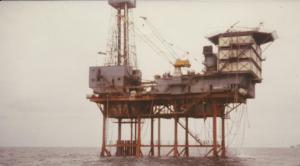
Although we were contracted to a competitive oil exploration company, our five-member dive team – two former SBS Royal Marines, one former Para (the nominal ‘Diving Supervisor’) and two former Royal Navy sailors – were working in a nearby sector just a short helicopter ride away. We received a radio plea for help … and offered a huge cash inducement for what appeared to be a seemingly straight-forward task. We agreed, and – with eight legs requiring attention – drew straws to see who would dive twice and earn a greater share of the bounty.
Each leg was accessed along what would, on the completed platform, be the lower catwalk. We were then required to climb ten-feet or so up one side of a rope ladder slung over the open top of the leg, negotiate the lip, climb down the inside of the flooded leg to the water’s surface, and then – while firmly grasping a loosely fastened shackle now firmly attached to the business end of the slack wire hawser – descend to the cone-shaped plug, retrieve the chain, attach it to the hawser with the shackle, ascend, climb up the inside ladder, clamber over the lip, and then climb down the outside of the ladder back on to the catwalk; all of which would be performed within the no-decompression time limits and while – because of the problems of effectively deploying an umbilical surface demand hose – wearing twin-cylinders. (In those days the concept of redundancy was considered an unnecessary extravagance. We used a single regulator attached to the manifolded twins. BCD’s were not even on the horizon of our thinking. Instrumentation was limited to a watch with rotating bezel set to the start of the dive. Fins were redundant in the tight confines of the pipe and, given the nature of the task, hand-held lights were equally superfluous.)
The first leg went without a hitch. I took the second leg.
Having negotiated the climb up and down the rope ladder to the water’s surface inside the leg, I took a firm hold on the shackle and wire, and – with ambient light restricted to the small opening at the top of the leg before being filtered through a thick layer of oil – quickly sank into total darkness. Feeling my way down the narrow tube, I eventually came to rest on top of the cone-shaped plug. Unable to bend little more than a few inches either forward or backward without either my head or the cylinders coming into contact with the circular 38-inch diameter walls of the leg, I began to straddle the cone in order to properly reach the chain. Reaching down between my legs, my hand brushed against the chain and dislodged the heavy links from their perch. Before I could grab hold of any part of the chain, the heavy links tumbled down into the sloping gap between the tube’s wall and the plug, firmly trapping one of my legs. After unsuccessfully struggling to free myself and only succeeding in over-breathing the regulator, I quickly came to the realisation that I was stuck.
Because of the equipment choice – and the belief that it was to be a quick and straight-forward task – we had no communications system that I could use to inform those back on the surface of my predicament. Attempts to haul my legs free of the entrapment by pulling myself up the hawser were thwarted by the fact that we had purposely left the wire free running. Pulling on it would only add to my woes by bringing coils of slack wire down around my shoulders.
Trapped in the pitch blackness and with the knowledge that it would be some while before those on the surface became aware that there might be a problem – and who, even then, would probably be unable to do much to assist – I struggled to quell a rising panic.
Bringing my breathing rate back under control, I managed to pull one of my legs free of the few links that had settled on that side of the plug. With the combined leverage provided by pushing against the side of the cone-shaped plug with my free leg and pressing downward with my hands against the walls of the tube I was, for short yo-yo bursts, able to ease the pressure on the trapped leg and, by wriggling my foot, gradually ease it free of the bulk of the chain to the point where I could eventually reach down and grasp the links. A process that – judging later by the time spent underwater – probably took less than twenty-minutes but that seemed to take so very much longer.
Slowly feeding the chain through my hand, I kept a firm hold on the final links while carefully feeling for the hawser and shackled end with my free hand. With fingers that were now puffy and softened by the water and the cold, I managed to secure the shackle to one of the chain’s links and the job was finally complete. All that remained was the ascent, an extended seat-of-the-pants decompression stop (our one concession to safety had been to rig a short, weighted line attached to the lower rungs of the rope ladder with decompression stops down to the 30-feet mark indicated by knotted pieces of hessian sacking) followed by the climb back up the rope ladder and down the other side to the safety of the catwalk.
I had survived another scare and added to the sum of my knowledge about diving safety and the mechanics of fear.
Q: What does the future hold for David Strike?
A: I have become – in recent years – more aware of the importance of family and the enormous debt of gratitude that I owe to them all for the patience and regard that they’ve always shown to me … and the love. (I met Sylvia while on weekend leave during my Navy diving course.)
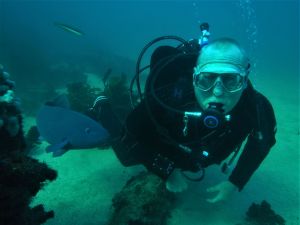 I’ll continue to dive for as long as health permits. I still have one or two more diving events that I’d like to have a hand in organising; I have a book or two based on modern diving history – and the personalities involved in its growth – in the offing; I have an on-going interest in the growth and development of diving through industry bodies; and – as far as possible – I hope to enjoy occasional social catch-ups with diving friends whose stories and exploits are worth recording for posterity.
I live close to the sea and can hear, as I close my eyes each night, the sounds of ocean breakers crashing on the shore. And again, on waking each morning. Life, in short, has been very, very good to me. And so much of it has been directly due to the people that I’ve been privileged to meet through diving.
As for the future? Knowing what is, with each passing year, looming closer, I’m not in any hurry to meet it head on. 😊
—-ENDS—-
The above transcription – in two parts – appeared in issues of ‘Scuba Diver UK’ magazine, in August and September 2023.
Categories: Profiles
 NEKTONIX