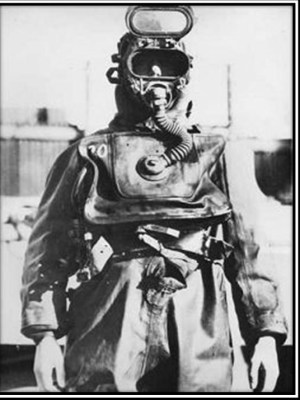
 Inspired by the successful WWII attack by six Italian divers riding three manned torpedoes on the British battleships, HMS Valiant and HMS Queen Elizabeth, then – in December, 1941 – at anchor in Alexandria Harbour, the British Prime Minister, Winston Churchill, sent a memo to the allied Chiefs of Staff, in early 1942, asking, “… what is being done to emulate the exploits of the Italians in Alexandria Harbour and similar methods of this kind. …. Is there any reason why we should be incapable of the same kind of scientific aggressive action that the Italians have shown? One would have thought we should have been in the lead.”
Rapid developments in technology and military actions often go hand. Within a short space of time the Royal Navy – appreciating the economic value of undersea craft manned by just one or two divers – had developed their own version of the Italian ‘human torpedo’.
Volunteers were called for “hazardous and arduous service” as divers, their numbers gradually whittled down until only a small nucleus remained. These were to be the ‘guinea pigs’ in a new striking arm of the Navy. Many would die whilst still under training and before they had a chance to attack the enemy. Others would meet death on operations alone in cold, dark waters.
By September 1942, four chariots and their crews were ready to carry out operations. 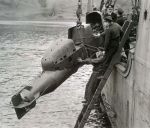
Although one of Germany’s most feared battleships, the Bismark had already been sunk, a second German Battleship, the Tirpitz, had been completed and was lying in Trondhjemsford in Norway, waiting for an opportunity to break out and attack the vulnerable merchant shipping convoys. The Tirpitz was chosen as the target for the Chariots ‘baptism of fire’.
On October 28th – the 21st birthday of Sub-Lieut. Jock Brewster – two chariot crews set sail for Norway. Carried across the North Sea beneath an old fishing trawler, two chariots were suspended by wires shackled to the stern while the ‘charioteers’ were disguised as deck crew. Sub-Lieut. Jock Brewster and Sergeant Craig were chosen as the number ones of the chariots, with Leading Seaman Evans and Stoker Tebb as their number two. Although managing to avoid detection by German patrol boats, the small trawler ran into a squall within 8kms of the Tirpitz. Plunging and rolling violently in the wind-whipped waves, the chariots were torn loose from their tow wires and were sunk in water too deep for recovery using the O2 rebreathers.
Despite this initial failure, successful Chariot operations took place in Italy, with, in January 1943, the sinking of the Italian Cruiser, UlpioTraiano lying behind strong defences in Palermo.
Attacks on Italian shipping continued unabated, culminating in the sinking of the heavy cruiser, the Bolzano in February 1944, the last of the cruisers with which Italy had entered the war.
Ironically, the Bolzano was sunk in the harbour at La Spezia, the birthplace of Italy’s ‘Human Torpedoes’ which, several years earlier, had issued forth to attack Gibraltar and Alexandria: a case of ‘chickens coming home to roost’.
— END of Part 1 —
Categories: History
 NEKTONIX