X-Craft
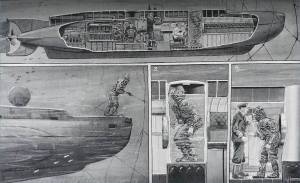 Developed by the Royal Navy, in 1942 during WWII, as a more potent undersea weapon than the ‘Chariots’, the X-craft were midget submarines manned by a crew of four – one of whom was the designated diver.
Embodying all the essentials of conventional submarines, but with everything reduced in scale, the stubby, cigar-shaped hull measured 51 feet in length by 5 feet 9inches in the beam, and a maximum height (close to the periscope) of about 5 feet 10 inches (about 180 cms)
Because of their limited range, the smaller X-Craft would be towed by a ‘mother’ submarine to their area of operation, usually ports or defended harbour areas sheltering enemy shipping. Carrying, like large blisters, detachable side cargoes of high explosive they would move in beneath an enemy vessel, release their cargoes onto the sea floor and then, theoretically, make their escape.
SAMSUNG
In practice this often entailed penetrating well-guarded seaways, anti-submarine nets and boom-defence obstacles, manoeuvres that frequently required the services of the diver, using an O2 rebreather, who would exit the submarine through the small wet-and dry lavatory compartment (a space that – having been privileged to go aboard one of the remaining X-Craft during the very early 1950’s – proved a tight fit even for a then skinny nine-year old) and, standing on the submarine’s hull, cut a passage through the nets and barriers; or, when beneath a target vessel, planting limpet mines on the unsuspecting target.
On 22 September 1943, six X-craft midget submarines – each manned by a passage crew and towed by a separate ‘mother’ submarine – set out from Scotland on ‘Operation Source’, their mission: to sink the feared German battleship, Tirpitz, sheltering in a Norwegian fjord. Three never reached the fjord. One being lost with all hands during the lengthy passage across the North Sea in rough weather.
Three X-craft remained to press home the attack. Presumed to have been sunk by the German defences alerted to the impending attack, Lt Henty-Creer, the Australian commander of X5, and his crew were never seen again. Only X6 and X7 remained. Both Lt Donald Cameron in X6 and Lt Godfrey Place in X7 placed their charges successfully, but were forced to surrender. Both were awarded the Victoria Cross.
Although Tirpitz was not sunk, she was put out of action until April 1944. Despite the successful outcome, the experiences of the passage crews taught several lessons in terms of future X-craft design and equipment, and, from a tactical perspective, that except in very special circumstances, future X-craft operations would be planned on the basis of one craft, one target.
—————–
In 2006, an expedition led by the late Carl Spencer and Leigh Bishop, from the U.K., and supported by the British and Norwegian Royal Navies employing some of the most sophisticated sonar and ballistic imaging equipment available to the military, carried out an exhaustive but unsuccessful search for X5 in the hope of discovering whether it had been able to press home its attack and release its side cargoes of high explosive beneath the Tirpitz.
However, an underwater explosion close to the Tirpitz, and witnessed from the surface by crew members, has given rise to the belief that X5’s side cargo may have exploded prematurely, destroying all trace of the submarine and its crew.
—————–
Postscript
Lt Godfrey Place, the Commander of X7, later transferred to the Fleet Air Arm, an unusual move for a submariner. Trained as a fighter pilot, he saw active service during the Korean conflict, and later – in 1966 – became the Commanding Officer of the Commando Carrier, HMS Albion, my last sea-going ship.
—————–
Image Captions
X-craft diagram from, ‘Deep Diving and Submarine Operations’ by Robert H Davis
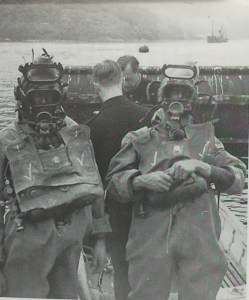
Australian Sub-Lieuts Henty-Creer (Left – CO of X5 during attack on the Tirpitz) & Max Shean (CO of X24 and, later, XE4.) during Diver and X-craft training. The bulky dress was later replaced by a more ‘streamlined’ model.
—- ENDS —
Categories: History
 NEKTONIX