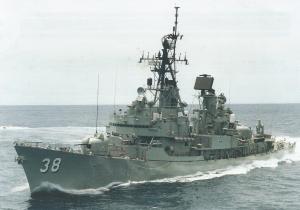
 At a few minutes past 08.00 on Saturday, 24th November 2001, the former Guided Missile Destroyer, HMAS PERTH, briefly lifted its bow to the sky before succumbing to the ocean waters invading its hull. Quickly settling upright on the seabed thirty-four metres below, and with only the top of its mast projecting through the boiling froth of escaping air bubbles, the former warship had become the world’s largest, purpose sunk, artificial reef and diving attraction.
Scuttled in the scenic waters of King George Sound – that marks the seaward approach to the town of Albany, at the south western tip of Western Australia – the sinking of the PERTH was the culmination of five years of planning by the organisers, the Albany Artificial Reef Group (AARG), to secure a world-class diving wreck: One whose final moments, when they came, were as dramatic as they were sudden.
Preparation
Gifted by the Royal Australian Navy to the Western Australia government when she was de-commissioned in 1999, the rights to secure the former HMAS PERTH as an artificial reef had been preceded by intense lobbying.
Successful in their bid, it was then incumbent upon AARG and the City of Albany, to raise the necessary funding and to prepare the vessel for sinking in accordance with the Environmental Protection Agency guidelines. With an estimated $1.5 million in sponsorships, an army of volunteers worked for almost two years in stripping and cleaning the vessel of any potential contaminants.
Leaning on the experience gained by the Canadian Artificial Reef Group, considered to be the world leader in preparing vessels for sinking as artificial reefs, the ship’s machinery, loose fittings and miles of electrical wiring and cables were removed; all traces of oil were cleaned from the fuel tanks; hatch covers and watertight doors were either removed or welded into the open position, and tonnes of lead ballast were removed from the bilges. A series of large holes were cut above the water line into the hull’s sides and deck plates, while compartments considered hazardous, such as the engine and boiler rooms, had been permanently sealed with metal grilles.
“Although diver safety has been paramount in the preparation, we have been at pains to leave as much of the wreck as possible intact so that divers can get a feel for what the ship looked like.” Said Ron Moore, of Albany Scuba Diving Academy, the key organiser who has worked tirelessly to bring his dream to fruition.
With so much of the superstructure, including the after 5-inch gun, left intact it was necessary to pour 100 tonnes of concrete and 100 tonnes of water into the bilges to provide stability during PERTH’s final tow to its new home, just 1.5 kilometres from the old whaling station and close to Seal Island in Frenchman Bay. An area protected from the prevailing weather that offers good, year-round diving.
For Canadian demolitions expert, Ron Gabriel, a former Navy Clearance diver and Explosive Ordnance Disposal (EOD) Instructor, the scuttling of the PERTH was to be the ninth such sinking that he’s handled. With forty-four shaped charges strategically placed around the vessel below the water line, his plan was to sink the vessel bow first so that it would submerge evenly and come to an upright position on the bottom.
Going down?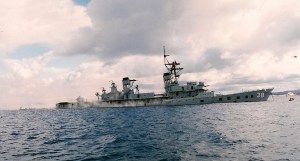
Before an estimated crowd of ten thousand people flocking to vantage points around the foreshores and a two hundred strong flotilla of spectator craft waiting beyond the one kilometre exclusion zone, the count down began.
In a fitting tribute the honour of pressing the button that would send the decommissioned HMAS PERTH on its final voyage was given to Arthur Bancroft, a former surviving crewmember of the original HMAS PERTH, sunk by enemy fire in the Sunda Strait, during the second World War.
Celebrating his 80th birthday on that same day, Arthur Bancroft pushed the button. There was an expectant pause, followed by a series of dull ‘crumps’ as the charges detonated; each one marked by a small puff of grey smoke that quickly dispersed. From our privileged position close to the stricken vessel, we watched as the sea gradually grew level with the gaping holes in the hull.
The weight of water rushing into the hull speeded the descent; and as plumes of white spray, carried aloft by the escaping air, billowed above the vessel, it became apparent that she was sinking by the stern! As the bow rose, the ship suddenly began a severe roll to port. “She’s going over!” somebody called. Still slipping beneath the surface and with the after decks awash up to the main superstructure, the ship continued to heel at an angle of about twenty-five degrees. Suddenly, as though remembering her new purpose, the PERTH sprang back on an even keel and dropped beneath the surface.
Although defying the original scuttling plan measurements taken with a plumb line from the top of the exposed mast showed that the PERTH had come to rest just two-degrees short of perfectly vertical to become – in a little over four minutes – possibly the most successful of any of the artificial reef wreck projects.
After thirty-four years of service – and the last Australian warship to come under enemy fire during the Vietnam War era – the former HMAS PERTH will now begin a sea-change: Proving the value of turning swords into ploughshares, her once stark lines will become softened by the encroaching marine life and provide enjoyment and wonder to generations of divers for the next 75 – 100 years.
Diving the PERTH
Although closed to members of the diving public until the wreck had been thoroughly checked for safety and cleared of any unexploded ordnance, a small group of us were allowed a preview dive of the PERTH on the following day.
With sunlight sparkling off of the blue waters of Frenchman Bay, we descended on the mast. Because commercial diving crews were still sinking marker and mooring buoys around the wreck’s perimeter and stirring up the sea floor, visibility at the start of the dive was reduced to about fifteen-metres. (By the dive’s end the slight current had quickly opened this up to twenty-five metres.)
From the top of the bridge we descended down onto the foc’sle and, at a depth of about 25-metres, moved toward the bow, passing across the top of the gaping circular hole in the deck that marked the former position of the for’ard 5-inch gun.
With her keel buried into the sand at a depth of about thirty-two metres, the grey hull stretched astern and disappeared into the distance. We swam back along the boat deck, pausing to peer into the huge holes cut into her sides, above each of which is a large cautionary sign advising divers that wreck penetration should not be attempted without appropriate training.
Not that this is quite so necessary in a wreck that has been properly prepared for diving by having alternate exits to each of the seventy-plus compartments that allow penetration, and where daylight is always visible. Adventurous souls can even descend down one or other of the two funnels and emerge on number one deck either for’ard or aft of the canteen, or safely descend into the after magazine that actually lies 1.5-metres below the sea floor at a depth of 36-metres.
With the barrel pointing astern, the aft 5-inch gun is the first major feature encountered by divers ascending from the seemingly vast expanse of the quarter-deck and moving back for’ard towards the superstructure and the circular dishes of the missile tracking systems.
The bridge is an obvious draw-card. Well lit by light penetrating from the two bridge-wing door openings and through the forward facing windows, the Captains Chair still remains in position in mute testimony of the ship’s previous life.
Moving higher up the vessel towards the end of the dive, the spars and platforms of the mast provide excellent resting places from which to view the vessel during the safety stop. And being so close to the surface will prove a colourful attraction to snorkellers’ as well as divers once the marine growth takes hold.
In just one dive on the PERTH, it’s impossible to gain anything other than a fleeting impression of the wreck. Surfacing at the stern of ‘Silver Star’ – the luxury day-boat from which we’d viewed the sinking – we were greeted by Ron Moore peering down at us. “How was it?” He asked. “Bloody magnificent!” was the reply.
———————
HMAS PERTH Facts
Type: Guided Missile Destroyer (Charles F Adams Class) built as DDG25. RAN Hull number – #38
Displacement: 4900 tonnes
Length: 133.2 metres (437 feet)
Beam: 14.3 metres (43 feet)
Speed: More than 30 knots
Propulsion: 2 GE geared steam turbines, driving two shafts and producing 70000 shaft horsepower
Laid Down: 21 September 1962
Launched: 26 September 1963
Armament: 2 x Mk42 Mod 10 5″/54 calibre single gun mounts
6 x Mk32 Mod 5 Torpedo tubes with Mk46 torpedoes
1 x Single Mk 13 Mod 5/6 missile launcher, with Harpoon & Standard (SM-1) missiles [originally Tartar]
2 x Ikara missile launchers [now removed]
Surveillance: 975 Navigation Radar [now removed]
AN/SPS-67 (V)1 Surface Search Radar [originally AN/SPS-10]
AN/SPS-40C Long Range Air Warning Radar AN/SPS-52C 3-D Air Warning Radar
AN/SPG-53F Gunnery Fire Control Radar
2 x AN/SPG-51C/D Missile Fire Control Radar sets
IFF Interrogator (2) and Transponder
AN/SQS-23K/L Hull Mounted Sonar
Builders: Defoe Shipbuilding Company, Bay City MICHIGAN USA
Commissioned: 17 July 1965 at Boston, MASS USA
Crew: 333 (21 Officers – 312 Sailors)
Decommissioned: Friday 15 October 1999
HMAS PERTH at War
From September 1967 to April 1968, and from September 1968 to March 1969, HMAS PERTH served as part of the US Seventh Fleet off the coast of Vietnam. Awarded the U.S. Navy Commendation by the US Secretary of the Navy for her first tour of duty, and the US Meritorious Unit Commendation by the Commander-In-Chief of the Pacific Fleet for her second tour, the PERTH covered 114,000 nautical miles during the Vietnam conflict; fired 23,400 rounds of ammunition; and sustained damage after coming under fire from shore batteries.
—ENDS—
(The above story was first published in the February/March 2002 issue of Asian Diver Magazine)
Categories: General
 NEKTONIX