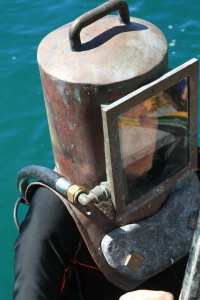
Test Diving the Simplex Mk 1 – image courtesy of Tricia Roe
Never believe folks who tell you that there’s no future in nostalgia; there’s much to be learned from a study of the past. And diving is no exception. Riding a growing global wave of interest in diving’s rich and sometimes bloody history, an increasing number of enthusiasts are breathing fresh life into old technology; one that, after almost two-hundred years, has become the iconic and universally-recognised symbol of diving: the standard diver’s helmet.
Now a ‘collectable’, rather than just an interesting curiosity of days long past, diving helmets have become sought-after items that reflect the status that divers – and diving – once enjoyed.
One-hundred plus years ago, in 1924, David Masters (son of a prominent salvage expert of the time) wrote, in his book, ‘The Wonders Of Salvage’: “Without the diver, treasure hunting beneath the waves would be impossible. The salvage expert may make the most brilliant plans, collect the most up-to-date and scientific plant to assist him, but in the end it is the diver who carries the work through, and upon the courage, determination and skill of the diver the success of the expedition depends. ….”.
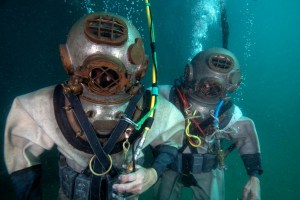
American Mk V Standard Dress divers – image courtesy of Lisa De Luca
Now a regular Sydney-based event – one that attracts members of Australia’s Historical Diving Society trained and qualified in the use of Standard Dress diving equipment, to travel from around the country to attend the themed Diving Day’s organised by former New South Wales Police Diver, Phil McGowen – the ‘Hard Hat’ diving days allow enthusiasts and dive helmet collectors an opportunity to better appreciate the technology of diving’s golden age.
Usually named after the manufacturer, or country of origin, of the main helmets to be dived, (as in the, ‘Siebe Gorman Helmet Dive Day’, the, ‘American Mark V Diving Day’, the ‘Australian Robison Dive Day’) each event features a variety of the copper, brass and bronze helmets that, between them, represent great moments in diving history. Lovingly restored to working order – and retro-fitted with a modern communications system that allows speedy and intelligible conversation between the diver and the surface support team – a majority of the helmets are far, far older than the most mature of those divers taking an environmental journey back in time.
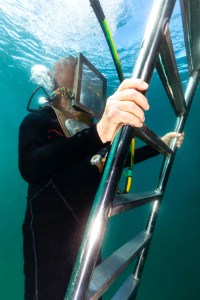
Image Courtesy of Lisa De Luca
Held at Clifton Gardens, on Chowder Bay – one of Sydney Harbour’s more scenic beauty spots – the jetty and its landing stage, where a former ferry service disgorged and took on passengers, has proven the perfect location for each of the themed diving days. The gently sloping sea-floor towards, and just beyond, the end of the jetty offers a reasonable depth of water between, say, seven- and twelve-metres, while the landing stage itself is the perfect platform for attaching the custom-built diving ladder. Designed and built by one of the diving members, Stephen Roe, the ladder’s rungs have a narrower distance between them than is usual. This allows a diver wearing heavily weighted boots to effortlessly descend and, even more importantly, to easily ascend the ladder at the end of a dive.
(A feat that, for a working diver wearing standard dress with helmet, corselet, breast and back-weights, heavy weighted boots and a thick canvas-twill-and-rubber-cuffed suit weighing in total around 180+lbs (82+ kgs) would have been no mean task after spending several hours at depth, in usually cold and murky waters, carrying out a heavy-duty assignment.)
In today’s world, the sight of wet- or dry-suit clad scuba divers gearing up for a dive at popular shore-diving locations has become commonplace. In that regard, little would appear to have changed in the past one-hundred years since the author of, ‘The Wonders Of Salvage’, wrote: “So commonplace is the diving dress that it no longer excites curiosity. Yet it remains one of the wonders of modern civilisation. …”
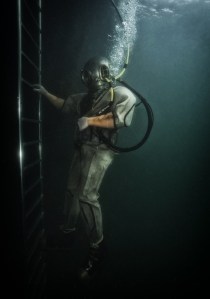
Standard Dress Diver – image courtesy of Lisa De Luca
But what might have once been considered commonplace is, today, a novelty, and there are no shortage of curious spectators watching the complex process of dressing the diver at our regular events. Once suited up, the final stages of dressing the diver involves attaching the helmet and ensuring a watertight seal with the suit. And this is where helmet designs frequently differ … and potential problems arise.
The helmet consists of two main parts, the bonnet – enclosing the divers head – and the corselet, or breastplate, that sits on the diver’s padded shoulders and to which the bonnet is then attached. Depending on the manufacturer, the corselet features a series of threaded bolts that correspond to holes in the heavy-duty rubber neck of the suit. With the suit and the breastplate securely clamped together, and the bonnet locked into place, the entire unit is, theoretically, watertight.
It then only remains to provide the diver with sufficient air to support life and prevent increased water pressure from crushing the suit. This is accomplished by a surface-supplied hose through which air, maintained at a pressure above that of the surrounding water, was once pumped down by hand but which, at today’s events, are managed by a control panel and plugged-in air cylinders, whose pressure gauges are monitored by the supervisor and surface support team.
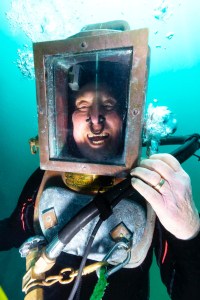 The whole dressing process, even though sounding remarkably simple, is time consuming and occasionally fraught with problems when a suit designed to be used with a traditional twelve-bolt helmet, is matched with a helmet having just six-bolts; a design favoured by the British Admiralty to speed up the dressing process, but one treated with suspicion by old-school commercial divers who frequently complained that the only reason that the six-bolt helmet had been adopted so readily by the Navy was that sailors had to use both hands to count to ten, and were incapable of counting to twelve without first removing a shoe and sock.
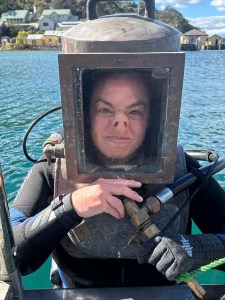
Lisa De Luca forgot the nose clip
Commenting as a former Royal Navy rating, there may have been an element of truth in the claims of those commercial divers favouring the 12-bolt helmet. However, even the dressing procedure using a six-bolt helmet took time, especially when the only requirement was for a quick ‘look-and-see’ task in shallow water depths.
This was something better accomplished by use of the ‘Shallow Water Diving Helmet’; essentially a simpler, negatively-buoyant version of the better-known standard dress diving helmet, consisting of a single surface-supplied unit that sits directly onto the divers shoulders.
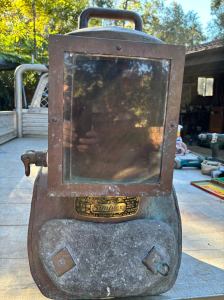
The SWD with Name Badge – image courtesy of Tricia Roe
Seldom considered by actual commercial divers as a valid piece of equipment, in particular the fact that should the wearer bend over to more easily recover an object from the sea floor, the helmet – open at its base where it perches on the diver’s shoulders – would quickly flood with water and, conceivably, drown the user, the Shallow Water Diving Helmet is still enormous fun to use.
A keen collector of diving helmets and artifacts – and unable to find an actual Shallow Water Diving Helmet – HDS member, Stephen Roe’s engineering skills prompted him to design and build his own. Having an old hot water heater whose basic shape lent itself to helmet design, he added a large viewing face-plate, an internal comms system, and a ‘belly-valve’ controlled surface supplied air system.
No longer measuring up to the fitness demands of diving (as nominated in, David Masters, 1924 book, ‘The Wonders Of Salvage’ when he wrote, “ … deep diving is very arduous, and seldom are men found with the physique that will enable them to dive 100 feet and over. The deep-sea diver must be trained like an athlete, perfectly sound in wind and limb and heart, and in tip-top physical condition.”) I was privileged to be one of two – the other being talented underwater photographer, Lisa De Luca – Ocean Test Pilots for Steve’s, ‘Shallow Water Diving Helmet’ design.
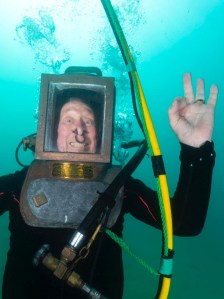 With a nose-clip firmly in place (to help equalise the helmet’s air pressure build-up on descent) I negotiated Steve’s ladder – both going up and going down – trod the ocean floor, and viewed the ocean in a very different way to that of either a scuba diver, or a standard dressed diver. It was great fun. Not least for the fact that the helmet managed to successfully support meaningful life – mine. But it did seem to lack a certain something … an accepted name, perhaps?
While traditional diving helmets will usually proudly carry the manufacturers name on the breastplate, Steve’s SWD Helmet remained anonymous. Until recently when – given its original provenance – Steve discovered a suitable name tag; a brass plate that once adorned an Australian electric hot-water heater, the ‘Simplex’.
Now a regular feature of the Standard Dress Dive days, the ‘Simplex SWD Helmet’ is a reminder that, in so many respects, diving is still in its infancy when it comes to technology.
—ENDS—
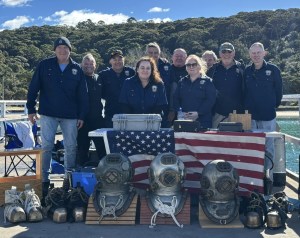
HDS Members at American MkV Dive Day – image courtesy of Tricia Roe
Categories: General
 NEKTONIX