 The article that follows relates to a dive trip to Papua New Guinea in early 1996.
——————
Papua New Guinea. Land of Adventure and Excitement. It’s everything that the travel brochures claim for it. And then some! Ragged mountain ranges bursting through thick green jungle; volcanically heated springs, pools and rivers; colourful and exotic bird life, and underwater scenery that is reputed to be among the best in the world.
Located wholly within the tropics, just south of the Equator and 160 kms to the north of Australia, Papua New Guinea occupies the eastern half of the world’s second largest island, which it shares with the Indonesian state of Irian Jaya. Not quite a part of Asia, and bedevilled by the growing pains of nationhood, it has, until recently, been largely ignored as a tourism destination.
That’s changing with the growing realisation that the waters of PNG offer some of the most exciting diving to be found anywhere.
If any doubts exist about diving’s prominent role in the country’s tourism mix they’re quickly dispelled the moment you step aboard an Air Niugini flight. The seat pocket magazine, ‘Paradise’, surely ranks as one of the world’s most lavish in-flight publications. Magnificent pictorial spreads on diving highlight the country’s hottest tourism asset. A quality of production reflected in every aspect of the national carrier’s service.
An attitude that we found duplicated on all of the domestic flights that carried us around the country on a PADI familiarisation trip in February, 1996.
Our eight day trip began in Madang, on the country’s north coast, took in the world acclaimed diving of Kimbe Bay, on the island of New Britain, and finished with a look below the surface of the Port Moresby area.
The Jais Aben Resort, at Madang, sprawls comfortably over twenty-two acres along the edge of the Bismark Sea. With Eighteen oceanfront units – each capable of sleeping up to four people – an open air restaurant, bar, pool and a well equipped dive store there’s little need to do anything other than relax and enjoy the tropical ambience.
The diving is varied. With two fast, well configured dive boats, wrecks and reefs are just minutes away from the resort and allow for a land-based surface interval between dives. And what dives they are!
Jais Aben’s resident diving Instructor, Clayton, showed us a selection of his favourite sites, where visibility was seldom less than thirty metres and where the water temperature remained a comfortable 30 deg. C. Every dive was preceded by a thorough briefing that included information on what we should look for and the profiles that we should observe. [In water clarity like this it’s all too easy to overlook depth considerations!].
‘Planet Rock’, an open ocean sea mount some 2 kms offshore, rises to within metres of the surface and supports a profusion of healthy corals. Colonies of clown and anemone fish are evident everywhere, together with large pelagics and the smaller, but more colourful and abundant tropical varieties.
A few metres from the tree lined shore of a small island, where the coral encrusted volcanic ridge drops sharply away into the depths, is ‘Barracuda Point’, named for the huge schools of barracuda that feed in the light current. During a drift dive we counted huge schools of barracuda intermingled with bat-fish and large, hump-headed Maori wrasse. At one point a large spotted eagle ray came swooping by.
On the morning of our second day at Madang, Clayton took us to ‘Magic Passage’, a drift dive to a maximum depth of about 30-metres. The walls of the passage are festooned with gorgonians and sea-whips, large cowry shells lay along its rubble floor, and barracuda, white-tip reef sharks and bat-fish cruised its length.
“That’s the most amazing dive I’ve ever had.” Said Kendall to his buddy, words tumbling out of his mouth as quickly as the regulator. “I just closed my eyes and drifted with the current. Why! I could have been anywhere!”
“Er! The idea is to keep your eyes open, that way you appreciate it even more!”
“Oh!”
Walindi Plantation Resort, set in the middle of a working copra plantation, has become one of the most acclaimed diving locations in PNG. Set among lush, landscaped gardens each of the thatched, hard-timber Bures provides a picture post card view of beautiful Kimbe Bay.
Many of the more spectacular sites are far out into the bay – an hour or more aboard the sturdy ‘V’-hulled dive boat. Surface intervals between dives double as a lunch-break and provide the opportunity to snorkel and explore some of the shallower reefs.
Underwater visibility in Kimbe Bay is seldom less than 40-metres – and often better – a feature that adds to its popularity among underwater photographers. The area’s reputation for the quality of the diving is well deserved. Even in the shallowest depths gorgonians grow to enormous size, dwarfing those to be found on the Great Barrier Reef. The shoals, reefs and sea-mounts are a blaze of life and colour, large pelagics intermingling with the huge variety of exotic tropical species.
On our second night at the resort I decided to turn in early, my ‘roomie’ [Ron Hunter from Fisherman’s Wharf in Forster] staying behind in the small bar debating the finer points of camera ‘f’ stops! I turned off the lights, crawled into my bed and drifted into that floating state between sleep and wakening. I became vaguely aware that the door had opened and closed, and even more aware of Ron’s comments as he tried – with limited success – to negotiate the darkened room toward his own bed.
A sudden yell, the pounding of feet across the floor and the dazzling brightness of room lights brought me out of my doze.
“What’s up?”
“There’s something in my bed and it’s hissing at me.”
“Hiss off! Ron!”
“No! Really! It could be a snake!”
I quickly leaped out of bed and joined him at the door as his bed, on cue, let out another sibilant spitting sound.
“OK! Ron! It’s your bed. You pull back the covers and see what it is while I hold the door open ready for a quick get-away.”
Ron cautiously approached the bed and, taking the edge of the sheet between thumb and forefinger, flicked back the covers.
In the centre of the bed lay a beetle about 6 centimetres in length, its black armoured carapace glistening in the light and its pincers clicking and searching for meaty prey!
As the major international gateway to PNG, Port Moresby is often overlooked as a diving destination. Perched on the edge of the Coral Sea and framed by a backdrop of the Owen Stanley Range [site of the ‘Kokoda Trail’], the nation’s capital city offers quality diving on the nearby Sinavi and Nateara Reefs.
The Dive Centre, then run by John Miller and David Flynn, offers a standard of professionalism, courtesy and service that’s on a par with the best in the world. Located at Port Moresby’s Ela Beach Hotel, The Dive Centre, provided us with a day’s diving aboard their heavy-duty vessel, the ‘M.V. Solatai’. Although the underwater visibility was of a lesser quality than that of Madang or Walindi, the reefs and passageways still offered a surprising variety of corals, sponges and marine life, the colourful, the exotic and the unusual.
“Now I know why you’ve painted your name across the blades of your fins!”
“Why’s that, Ron?
“So that we all know exactly who it is that’s been kicking us in the face!”
A communal chorus of, “Yes!”
Further along the coast – and only minutes from the airport – is Bootless Bay, a sheltered inlet of crystal clear waters and small, green islands. Loloata Island is the Robinson Crusoe idyll. Modern, airy bungalows perch out over the water, their wide verandahs perfect places for apres-dive drinks.
On our second – and final day in PNG – John Miller arranged a visit to the Loloatu Island resort where manager, Dik Knight, proudly showed us around the facilities that mark the island as the perfect, ‘get-away-from-it-all’ destination.
The eight days flowed quickly by. A medley of scenic wonders, attractive and comfortable accommodations, fine dining and magnificent diving in the company of like-minded individuals. Jayne Jenkins, PADI Travel Network’s manager, had arranged every aspect of the trip with care. Even the legendary cyclones that previously dogged her travels laid low for the duration. For the rest of us it was an overview of PNG’s emerging status as a major international diving destination. One that’s only served to whet the appetite for more of what this fascinating country has to offer.
“Sir!”
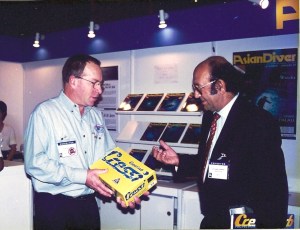
Ron – my dive buddy on our trip to PNG – at the 1997 ADEX Show in Singapore and about to discover that, “Revenge is a dish best served cold.” 🙂
I surfaced from my light slumber. “Yes?”
The hostess aboard our homeward Air Niugini flight smiled as she leaned across the now empty aisle seat next to me and passed me a drink.
“Your grand-son’s taking very good care of you. You must be proud of him!”
“Whaaaat??”
“Your grand-son, Rodney,”, she indicated the empty seat, “came and asked if his grand-father might have another drink!”
I thanked her, settled back, and dreamed of ways of sharpening those fin blades!
—ENDS—
(The above article – written in March 1996 following my return from Papua New Guinea – first appeared in DiveLog Australia a month or so later.)
Categories: Destinations
 NEKTONIX