
HMS Invincible returns to massive celebrations following the Falklands Conflict in 1982.
A forgotten South Atlantic ‘outpost’ of the former British Empire, the Falkland Islands came to public gaze when, on 20th April, 1982, Argentina’s ruling Junta asserted their claim to the islands by seizing military control. Their actions elicited a military response. Quickly assembling an armada of ships, a military force tasked with re-establishing British Sovereignty over the disputed islands, the fleet set sail from the U.K. bound for the South Atlantic. Included in the armada was the light aircraft carrier, HMS Invincible.
Just a few months earlier the Australian government had, after protracted negotiations, agreed to purchase HMS Invincible as a replacement for their one remaining aircraft carrier, HMAS Melbourne. The Falklands conflict put an immediate halt to the sale, and the following year, with the ‘blessing’ of the Australian Prime minister, Malcolm Fraser, the Ministry of Defence in the U.K. withdrew the offer to sell in order to maintain a revised policy of having three aircraft carriers.
In December 1983, HMS Invincible visited Sydney. Refusing to either confirm or deny the presence on-board of nuclear weapons, the ship was denied dry-dock privileges. Nevertheless, the ship’s stay was welcomed by Sydney-siders. It was especially enjoyable for me when I discovered that two former shipmates were on board; one was the late, “Mac” Cutting, the senior METOC (Meteorology/Oceanographic) rating, while the other was my good friend, John Whitehead, now a Lieutenant Commander and the ship’s Executive Officer, and my colleague from the small ASWEPS (Anti-Submarine Warfare Environmental Prediction System) unit in Whitehall, and whom I’d last met while in Singapore in 1968 and 1969.
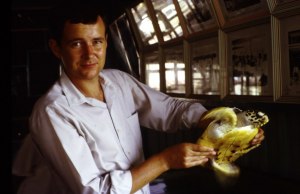
John Whitehead in Kukup, Malaysia, 1969
Given the opportunity to reciprocate the hospitality and kindness that John and his wife, Heather, had shown to me while I was on HMS Albion, stationed in Singapore at that time, Sylvia and I took enormous pleasure in taking Mac and John on sightseeing tours in and around Sydney, followed by frequent B-B-Q’s and parties with friends. It was a very memorable Christmas. Made more so when, in late December, John invited Sylvia and myself to be his guests in a pre-departure dinner in the wardroom.
Following dinner, and, for Sylvia, one or two post-dinner, “South Atlantic Knee Tremblers”, a cocktail peculiar to HMS Invincible, we were given a tour of the ship. Strategically hidden beneath large tarpaulins were objects that, when pressed to reveal what they were, we were told that the presence of nuclear weapons on board could neither be confirmed or denied.*
The following morning, we stood on North Head, at the entrance to Sydney Harbour, as HMS Invincible passed through on its homeward voyage to the UK.

The setting for dinner in Nelson’s cabin
It was a dinner eclipsed by a later 1990 invitation from John (subsequently appointed as Commanding Officer of HMS Victory – Lord Nelson’s iconic flag-ship at the 1805 Battle of Trafalgar – and now a permanent fixture in Portsmouth dockyard) for Sylvia and myself, then attending a newspaper publishers conference in Hamburg, Germany, to join Heather and himself and eight other invited guests to a formal dinner in Nelson’s Cabin, aboard HMS Victory.
In the few years that followed HMS Invincible’s visit, her two sister ships, HMS Illustrious, and HMS Ark Royal visited Sydney. The first as one of the warships taking part in the Royal Australian Navy’s 75th anniversary Fleet Review, in 1986. And the second in the Australian Bi-centenary celebrations in 1988. In both instances, Sylvia and I enjoyed the shipboard hospitality shown to us by people with whom I’d served and who now held senior positions in the Royal Navy.
None, however, were as enjoyable as that visit by HMS Invincible … and the catch-up with John. God speed, old mate, you were a great and very valued friend.
—ENDS—
Categories: General
 NEKTONIX