A continuation of the two earlier pieces on underwater communications, “Dive ‘Talk’ 1 – Manual”, and, “Dive ‘Talk’ 2 – Accoustically Speaking.”
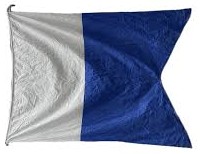
Flags:
Flown from a vessel tendering to divers, or from a tethered surface safety float – especially when diving in waters with busy surface traffic – the diving flag indicates that divers are below. Ideally the flag should be rigid and clearly recognisable for what it signifies. While there are regional variations in the flag used – most often in inland waterways – Flag Alpha has international recognition. Nevertheless, the rules governing its use and the precautions that other surface craft are expected to take when approaching a vessel or float displaying the flag will vary.
Hand Signals:
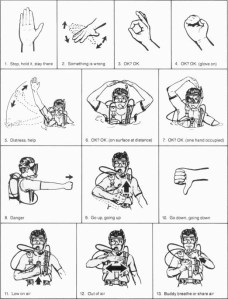
PADI Hand Signals
Universally taught as the primary means of underwater communication when diving recreationally, a hand signal’s effectiveness relies on divers being in visual contact with one another: In that regard their value is limited by visibility, the ability to attract another diver’s attention, and how well the signals are executed and interpreted.
In the same way that some people have difficulty in communicating the spoken word because of a tendency to mumble, hand signals should be theatrical flourishes that leave no doubt as to their meaning.
In a well-planned dive, there is often little need to communicate anything more elaborate than basic intentions or to draw attention to difficulties. However, it is worth remembering that regional variations in hand signals do exist. One person’s “ascend” sign may be interpreted by another diver as the, “OK” signal. For that reason alone, a review of hand signals and their meanings should be a key part of all pre-dive briefings.
Although it’s a small ‘vocabulary’ that is quickly and easily learned, surprisingly few divers know – or use and understand – anything other than a very few of the basic hand signals.
Written Communications:
Useful for recording details of a dive, (sketching features of a wreck, for example) and for noting in advance key aspects of a complicated dive plan – like planned decompression stops that can then be carried with the diver and referred to at will – slates and wet-notes also allow divers to communicate with one another using the written word.
Wasteful in terms of the time taken to jot down a message and then for another diver to read and comprehend its meaning, written communication lacks the immediacy of other techniques. It is also dependent on the divers being close together, reasonably good visibility, and how legible the handwriting, (particularly when the writer is wearing thick gloves; has cold hands and numb fingers; or is affected by narcosis.)
Underwater Lights:
Apart from providing essential illumination in conditions with low ambient light, (as in a night dive or penetration dive) an underwater light is also a communication device for use above and below the surface.
On the surface, at night, it can be used to indicate to boat or shore whether the diver is OK, or in need of help? Underwater, it can be used as an attention-getter by moving the light beam rapidly back and forth in front of a buddy or team member and then directing it onto, for example, a hand-signal or contents gauge. (Under no circumstances should the light ever be shone directly into another diver’s eyes.)
Again dependent on good visibility. to be effective, lights are ill suited to underwater use in turbid waters, where the reflected backscatter from particles may lead to disorientation.
—ENDS—
Categories: General
 NEKTONIX