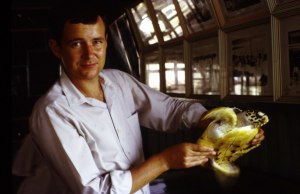
John Whitehead
Death seems intent on proving itself to me to be life’s last ‘Great Adventure’.
On the weekend of October 4th & 5th 2025, yet another of my closest – and longest lasting – friends died. John Whitehead was a man who – for over sixty-years – has never forgotten the value of friendship. And whose passing marks the end of a code of conduct that no longer exists.
Because submarines played such a crucial role in intelligence gathering during the Cold War era, considerable effort was spent researching their roles in both defensive as well as offensive operations. Understanding the environment in which they operated had a high priority and led to greater resources being directed towards a better understanding of physical oceanographic concepts.
In very early 1966 – having on my return from the Far East in the latter part of ’65, now been ‘qualified’ as a Meteorological/Oceanographic Observer – I was drafted to a small newly-formed unit called ASWEPS (the acronym for Anti-Submarine Warfare Environmental Prediction System) attached to the Fleet Weather Centre, based at the Admiralty, in London’s Whitehall.
Already operating for some while prior to my joining, the ASWEPS unit – in an underground office buried deep in the Citadel backing on to London’s Horse Guards Parade – consisted of two Lieutenant-Commanders, a Petty Officer, a Leading Hand, and two (three with my arrival) Naval ratings. One of whom was John Whitehead.
The ASWEPS office was a cosy jumble of desks and filing cabinets with, covering one entire wall, a map of the world that we presumed to be a hang-over from the war years. Having been introduced to everyone, and assigned a shared desk space, I was given a crash course in Oceanography For Dummies 101, by John, and told that I would soon be despatched to Malta where I would carry out diving work for a civilian Doctor of Physics engaged in cutting-edge research into the ocean’s thermal structure.
Leaving the predictable and regimented life of the regular Navy behind, I’d suddenly graduated to one where I no longer had to wear a uniform. A privilege that, according to the regular security lectures we were obliged to attend, carried with it an awareness of the fact that files on each of us were being maintained by the Kremlin, in Moscow.
Over the years, our paths – Johns and mine – continued to cross. John, his wife, Heather and their then young son, Simon, were based in Singapore during the late ‘Sixties and always invited me – as a ship-based oik at the time – to spend weekends as their house guest in Malaysia’s, Johore Bahru. We later caught up again when John, as Executive Officer of HMS Invincible – the flagship vessel of the U.K. fleet during the Falkland’s War – visited Sydney in 1983.
And – although we always maintained regular contact via letters, emails, and ‘phone calls – again in 1990 when, as guests of John and Heather, Sylvia and I were invited to a formal dinner aboard John’s then command, HMS Victory – Nelson’s flagship at the 1805 Battle of Trafalgar, now conserved as a lasting memorial, in Portsmouth Dockyard.
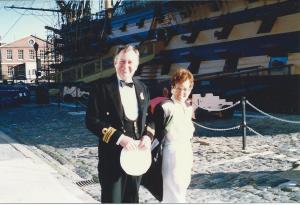
John and Sylvia in 1990
Although we later caught up during visits to Australia by John and his daughter, Fiona, our regular catch-ups were via ‘phone and internet. One particular “near-visit” being particularly notable and one that I now wish – more than anything – had taken place.
Having always celebrated the anniversary of the Battle of Trafalgar and the death of Vice-Admiral Horatio Lord Nelson – who, on the 21st October 1805, fell in the hour of victory over the combined French and Spanish fleets – it seemed a suitable anniversary on which to base a social activity get-together of Australia’s diving industry.
Twenty-years ago, in October 2005, I arranged the first of an annual series of luncheons based on, ‘Trafalgar Day’. Usually held on a Friday closest to the actual date – the rationale being that attendees would have the entire weekend in which to recover – the Trafalgar Day lunch sessions were attended by a cross section of industry personnel.
Following a vague ritual that included talks on historical aspects of the battle itself, toasts – taken in rum – and souvenir placemats filled with Naval trivia, the event attracted a strong following.
Having always invited people with whom I’d served to attend the lunch, my mate, John Whitehead – at that point in time still the Commanding Officer of Nelson’s Flagship, HMS Victory, in Portsmouth Harbour – accepted my offer to deliver a talk on the events leading up to the battle, and on the battle itself.
Having logged a more than sufficient number of Frequent Flyer Points, but only able to spend the one weekend away from Portsmouth, John had arranged to fly from the U.K. to Sydney – fully-booted-and-spurred in ceremonial dress with ceremonial sword – have a hire car pick him up at the airport, drive him to Manly, on Sydney’s Northern Beaches, and the Steyne Hotel; briefly attend the lunch and give the address, plus the Toast to ‘The Immortal Memory’; say farewell, and have a hire car pick him up and return him to Sydney airport for the afternoon return flight back to the U.K..
Fortunately (more so for John, rather than myself) a ‘secret squirrel’ demanded John’s time over that particular weekend … but I still think that it would have been the stuff of legends had he managed to actually attend; and one that all of us would have dined out on for years to come.
God speed, Mate. You really were one in a million. And your passing leaves a hole in the fabric of friendship that will never be filled.
—ENDS—
Categories: General
 NEKTONIX