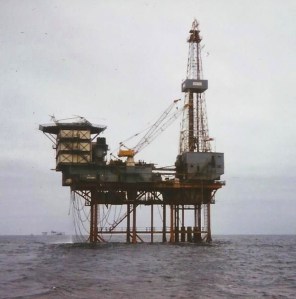
 In the early ‘seventies the heavy demand for divers to work on the North Sea gas and oil platforms exceeded supply. Wages were high. So was the diver mortality rate.
Confronted by a harsh environment and difficulties not previously encountered elsewhere in the world, many diving contractors found it more expedient to employ people with military diving experience. Their training would, it was believed, give the divers a survival edge.
As one of eight divers, I joined a team of other ex-military personnel with the contract to service all of one large oil company’s offshore platforms and rigs. Based on a roster system of two weeks on the rig and one week ashore there were always five divers on call.
On one occasion, we were employed in fitting anti-scouring devices to the legs of a drill platform almost midway between the UK and Holland, an area subject to strong tidal currents. Surface Demand Diving Equipment was not – at that time – mandatory and it was standard practice to choose equipment based on the job in hand.
On this occasion our equipment consisted of twin tanks; single-hose, up-stream regulators with an SPG, (no Alternate Air Sources.); No BCD’s – in any event our collective ‘wisdom’ suggested that they would only prove a bloody nuisance. And for thermal protection we wore 6.5 mm wetsuits.
Normal practice was to dive in two separate sticks. The first three divers – standing in a purpose-built steel basket – would be lowered into the water by crane from the platform’s deck. After decompressing on a buoyed line, the divers would return to this basket and be hauled back up to the platform deck. The remaining two divers were quickly briefed on the work status and the process was then repeated.
On a Sunday morning, my buddy and I – already dressed in wetsuits – looked down from the platform’s deck as the first three divers left the basket. A short while later one of the divers surfaced. 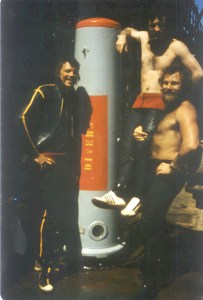
Struggling to reach to reach the safety line that trailed from the basket he appeared to be losing headway. Reacting to the situation, I grabbed a mask, weight belt and fins, slid down the ladders to the lower catwalk – about 3-metres above the waves – donned the gear and launched myself into the water. After several minutes of furious swimming, I paused to check my position. My enthusiasm had carried me beyond the distressed diver – whose efforts to reach safety had finally been rewarded. It was now my turn to be swept away from the platform.
Finally giving up the attempt to fight against the current and breaking waves, I turned my back on the weather and drifted, secure in the knowledge that my predicament was known to those on-board the platform and that help – in the form of a stand-by vessel tasked among other things with picking up survivors in the event of a disaster – would soon arrive.
After thirty-minutes – with my weight-belt still in place to provide stability and offset the buoyancy provided by the thick neoprene – a trawler, the ‘MARGARET CHRISTINA’, hove alongside, a scrambling net was lowered and I was quickly on deck.
Cold rather than exhausted, I was asked how I took my tea. “Black without sugar” I replied. A crewmember handed me a large mug of thick, hot tea. I greedily drank it and was handed another.
My transfer back to the platform should have been a simple exercise. Because of the rising sea state, it wasn’t. The plan involved lowering a personnel transfer basket – rather like a large lifebuoy with a rope cage – from the platform down to the water’s surface. With a lifeline secured about my waist, I was to leap from the trawler and swim towards it.
Wearing weight belt, mask and fins – and trailing a lifeline paid out by one of the crewmembers – I leapt into the sea and swam towards the floating basket. As my fingertips touched its side, the line tautened. To avoid collision with the rig, the ‘MARGARET CHRISTINA’ had quickly turned away from the structure. Conscientiously following instructions, the crewman tasked with holding the rope refused to release his hold. Dragged backwards through the water, I managed a piercing scream, “Let – gluuurg. – go – gluurg. – of the – glurg. – @.#$*&% rope.“. He did. And I was hoisted back on to the platform with my dignity bruised – but with my weight-belt still firmly in place.
Several months later, we were tasked with surveying the seabed around a new, unmanned, production platform recently constructed next to a drilling-rig. The water depth was just in excess of 160-feet with an ascent/descent line running from the drilling rig’s catwalk down to the base of the production platform.
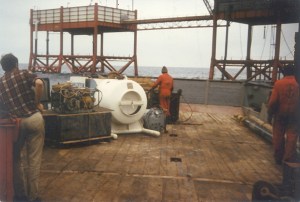 It was a sunny day with the lightest of swells. A supply boat, with its stern moored to the drill rig, was preparing to offload stores and drill pipe when we entered the water. On this occasion, my buddy – new to the team – and I were the first to dive while the second group of three divers stood ready on the lower catwalk.
Despite the surface conditions it was midnight dark at depth and we both carried lights. Our plan was to follow the horizontal struts connecting each of the legs while sketching ‘mud maps’ on slates as we went. Because of the reduced visibility we were no more than an arm length from each other. Two or three minutes after arriving on the bottom – while traversing the first strut – my regulator went ‘POP’. I gave a tentative suck on the mouthpiece. Instead of air, I received a trickle of water.
I immediately reached for my buddy, briefly shone the light on my face, spat out the regulator and indicated that I was in distress. He stared at me. I plucked his regulator from out of his mouth and took a healthy suck of air. He seized it back. In my mind’s eye, I had a vision of us both buddy breathing and making our way back to the ascent line. His view of the situation differed from mine. He disappeared.
Rather than ponder my predicament, I finned hard towards the surface. It would be nice to be able to say that I had calmly assessed the situation and was totally in control. Regrettably, I can’t. All that I can say is that some prior training must have automatically kicked in. I ditched my weight belt and, keeping my airway open, “Aaaahhed” all the way to the surface.
At the surface, I registered the fact that the tidal flow had carried me some way from the platform. Despite the post-adrenaline exhaustion my legs continued to pedal as I took in great gulps of air. Barely managing to keep my head above water, I became convinced that I would be swept away and, succumbing to cold and fatigue, become another statistic in the rising death toll.
Back on the platform our predicament had gone un-noticed until the skipper of the supply boat – who’d been standing on the bridge scanning the nearby ocean with binoculars – spotted two figures on the surface. A radio call went out for the nearest stand-by boat to search the area.
Exhausted – and lacking the good sense to ditch the twin-cylinders – my head was constantly dropping face down into the water as a stand-by boat pulled alongside. I was scooped out of the water and dumped onto the deck. My cylinders were removed and I rolled over into the scuppers where I lay face down being violently ill.
A short while later, I registered the fact that a voice was saying, “You could probably use a hot mug of tea. How do you take it?” I heard my buddy’s reply and then the first voice saying, “What about your mate?” I rolled over. “Well, bless my soul. It’s you, Strike. Black tea, no sugar, isn’t it?”. I was back aboard the ‘MARGARET CHRISTINA’. 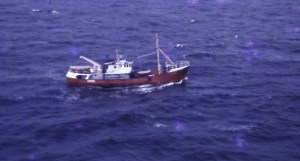
We were both quickly transferred to the drill rig. Following a stint in the Deck Decompression Chamber for “observation”, the first thing that I did
was to bitterly complain about the fact that the Chief Diver had presented me with an invoice for the dropped weight-belt. The second was to send a radio message “IOU” for drinks to the crew of the, ‘MARGARET CHRISTINA’.
Postscript
With an eye on bottom line profits – and not a little greed – what, even then, should have been regarded as obvious and common-sense safety procedures, went by the board. While we planned each underwater task in meticulous detail we rarely, if ever, discussed or prepared ourselves for the, What if’s … of diving. The dive plan itself was virtually non-existent as far as emergency drills were concerned. In fact, a cynic might claim that our diving practices were appalling. With the wisdom of years and the benefit of hindsight, I’m inclined to agree.
—ENDS—
The above story – published in two parts elsewhere on Nektonix – appeared in its entirety in the book, ‘Close Calls’, by Stratis Kas, that was published in late 2020.
Categories: General
 NEKTONIX