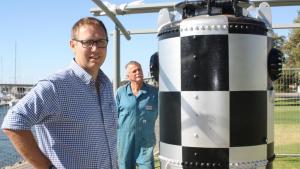
Richard Harris and Ken Smith with Reg Sprigg’s diving chamber which they have restored and installed next to the Patawalonga in Glenelg North. Picture Eugene Boisvert. (Adelaide Messenger )
A scientific ‘all-rounder’, South Australian, Reg Sprigg (b.1919 – d.1994) was a geologist and early environmentalist whose many credits include the discovery of the world’s oldest fossils in South Australia’s, Flinders Ranges and the first person in Australia to make detailed scientific studies of the deep ocean seafloor.
A skilled inventor who took up scuba diving in the early 1960’s, Reg Spriggs hand-built a diving chamber that, during the 1960’s, enabled scientists to conduct studies of the Gulf St Vincent and Investigator Strait sea floors – the first studies of their kind in Australia that led to the discovery, off South Australia’s Kangaroo Island, of canyons similar in size to those of the USA’s Grand Canyon.
Used in more that 560 dives to depths of more than 50-metres, the chamber allowed a maximum of two researchers opportunity to study the sea floor through observation windows, and was instrumental in surveying more than 3,000 square kilometres of the South Australia coast, before being ‘retired’ to the Sprigg family’s property, at Arkaroola Station, in South Australia.
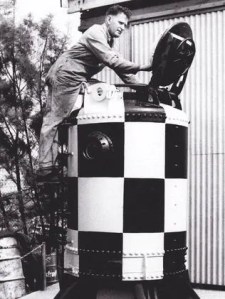
Reg Sprigg with his 1960s handmade deep dive chamber.
Discovered in 2012 by Dr Richard Harris – the diving physician who played a crucial role in the 2018 Thai Cave Rescue – and Ken Smith, the pair set about restoring the chamber at their own cost; a four-year project helped and assisted by the late Bob Ramsay and fellow diver, Peter Costello.
The restored chamber was finally installed as a permanent memorial to Reg Sprigg’s many scientific and cultural achievements at Glenelg North, close to where Sprigg lived, on December 7th 2016.
—ENDS—
Categories: History

