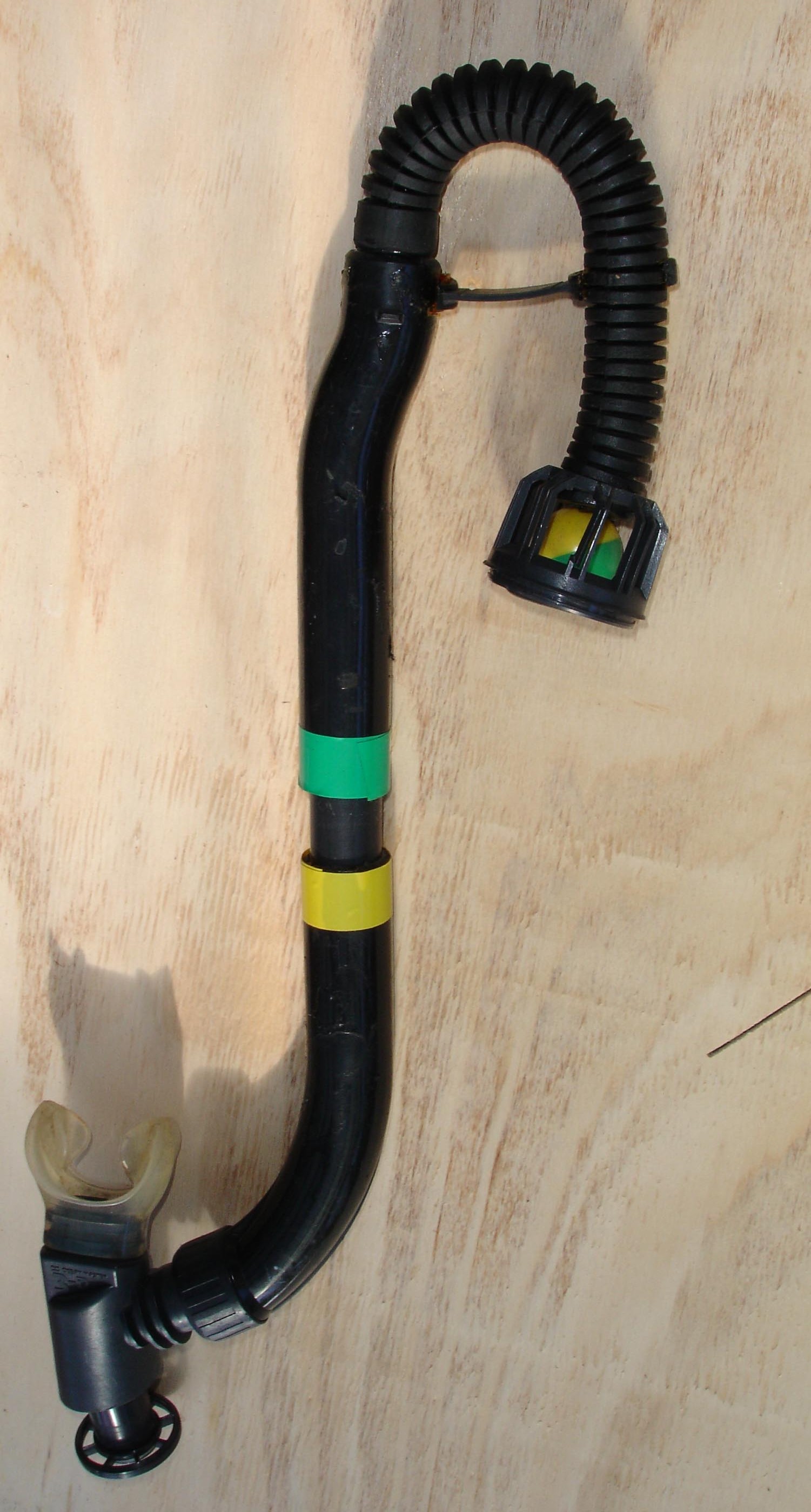
Nitrox snorkel prototype
The following article was first published in Asian Diver Magazine in 1996
____________________________
Claimed by its designers, an international consortium of diving technologists, to be the world’s first enriched air snorkel, ‘Uranus’ attracted considerable interest among those in the technical diving community invited to the launch preview held during the recent Tec-Asia ’96 Conference, in Singapore.
Resembling the 1954, U.S. Divers model snorkel, ‘Uranus’ features an eighteen-inch [45 cm] black graphite tube with one-inch [2.54 cm] bore; a reservoir well at the lower end, fitted with a non-return purge valve for easy clearing, and a soft, moulded mouthpiece for comfortable grip.
Depending from the reservoir well a manually operated spindle valve activates a membrane adsorbent located in a canister midway along the stem of the snorkel, a device that serves to filter unwanted gases from the mix.
Unlike modern conventional snorkels the top of ‘Uranus’ curves downwards and is fitted, at its end, with an open sided ‘cage’ housing the micro-chip sensor device, a ping-pong ball shaped instrument that automatically switches the mix to 21% oxygen on the surface.
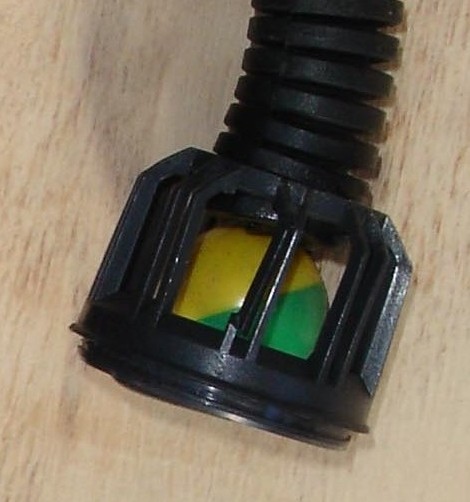
Micro-chip sensor
Presently available in two models for use with 32% and 36% O2 mixes, the designers of the ‘Uranus’ snorkel predict that there will be a full spectrum of models compatible with all Enriched Air Mixes up to 50% available by the early part of 1997.
“New techniques require new technologies,” said David Strike, Marketing Director and co-designer of ‘Uranus’, “and we believe that this instrument will revolutionise the way in which many technical divers regard the snorkel.”
“The concept of a ‘Nitrox’ snorkel has sparked the imagination of many in the technical diving community,” added Wings Stocks, “and we are already well advanced in our design plans for a model, incorporating a twin-hose mouthpiece, for use with all rebreather models.”
The design company, Zymurgy Inc. – with offices located in Australia, the USA, and the U.K. – are believed to be presently involved in negotiations with a number of leading equipment manufacturers keen to negotiate the world-wide marketing rights to this exciting new product.
—ENDS—
Postscript
An original concept given life by Wings Stocks and myself over a bottle of bourbon – and later shared with others – the originally named, “Stostri Super Wet Nitrox Snorkel” – as announced in the original launch press release – was much later adapted to include others present at that conference with the inclusion of the following:
“At the close of the first Tec-Asia Diving Conference – held in Singapore in 1996 – several of the speakers repaired to the Billiard Room bar of Raffles Hotel to enjoy a quiet drink. Inevitably, the conversation drifted towards technical diving and the challenges that its future development posed to equipment manufacturers.
Inspired by the efforts of the bar staff, we decided to launch our own equipment manufacturing company that later became, Zymurgy Inc.; a word that, according to my battered copy of the Oxford English Dictionary, is defined as that, “branch of applied chemistry dealing with the science of wine-making, brewing, and distilling.”
Given that all of the company’s founders had, from the perspective of consumers, significant knowledge of all three aspects of that branch of chemistry, ‘zymurgy’ always struck me as an appropriate name.”
Recently, a number of people have – because, I later included them in subsequent releases – claimed to be co-originators of the snorkel (as well as subsequent, Zymurgy products). Following is the original release:
MEDIA RELEASE
The World’s First Enriched Air Snorkel
Launched At ADEC ‘96
Claimed by its designers, an international consortium of diving technologists, to be the world’s first enriched air snorkel, the ‘STOSTRI Super-Wet’ attracted considerable interest among those in the technical diving community invited to the launch preview held at ADEC ‘96, in Singapore, in late May.
Resembling the 1954, U.S. Divers model, the ‘STOSTRI’ features an eighteen-inch [45 cm] black graphite tube with one-inch [2.54 cm] bore; a reservoir well at the lower end, fitted with a non-return purge valve for easy clearing, and a soft, moulded mouthpiece for comfortable grip.
Depending from the reservoir well a manually operated spindle valve activates a membrane adsorbent which is located in a canister midway along the stem of the snorkel. A device that serves to filter unwanted gases from the mix.
Unlike modern conventional snorkels the top of the ‘STOSTRI’ curves downwards and is fitted, at its end, with an open sided ‘cage’ housing the micro-chip sensor device, a ping-pong ball shaped instrument that automatically switches the mix to 21% oxygen on the surface.
Presently available in two models for use with 32% and 36% O2 mixes, the designers of the ‘STOSTRI Super Wet’ snorkel predict that there will be a full spectrum of models compatible with all Enriched Air Mixes up to 50 % available by the early part of 1997.
“New techniques require new technologies,” said David Strike, Marketing Director and co-designer of the ‘STOSTRI Super Wet’, “and we believe that this instrument will revolutionise the way in which many technical divers regard the snorkel.”
“The concept of a ‘Nitrox’ snorkel has sparked the imagination of many in the technical diving community,” added Wings Stocks, “and we are already well advanced in our design plans for a ‘STOSTRI Super Wet’ model, incorporating a twin-hose mouthpiece, for use with all rebreather models.”
The design company, Zymurgy Inc. – with offices located in Australia, the USA, and the U.K. – are believed to be presently involved in negotiations with a number of leading equipment manufacturers keen to negotiate the world-wide marketing rights to this exciting new product.
For Further details contact:- Zymurgy Inc., …….(Details now changed.)
—ENDS—
Categories: Counter-Strike
 NEKTONIX
Leave a comment